

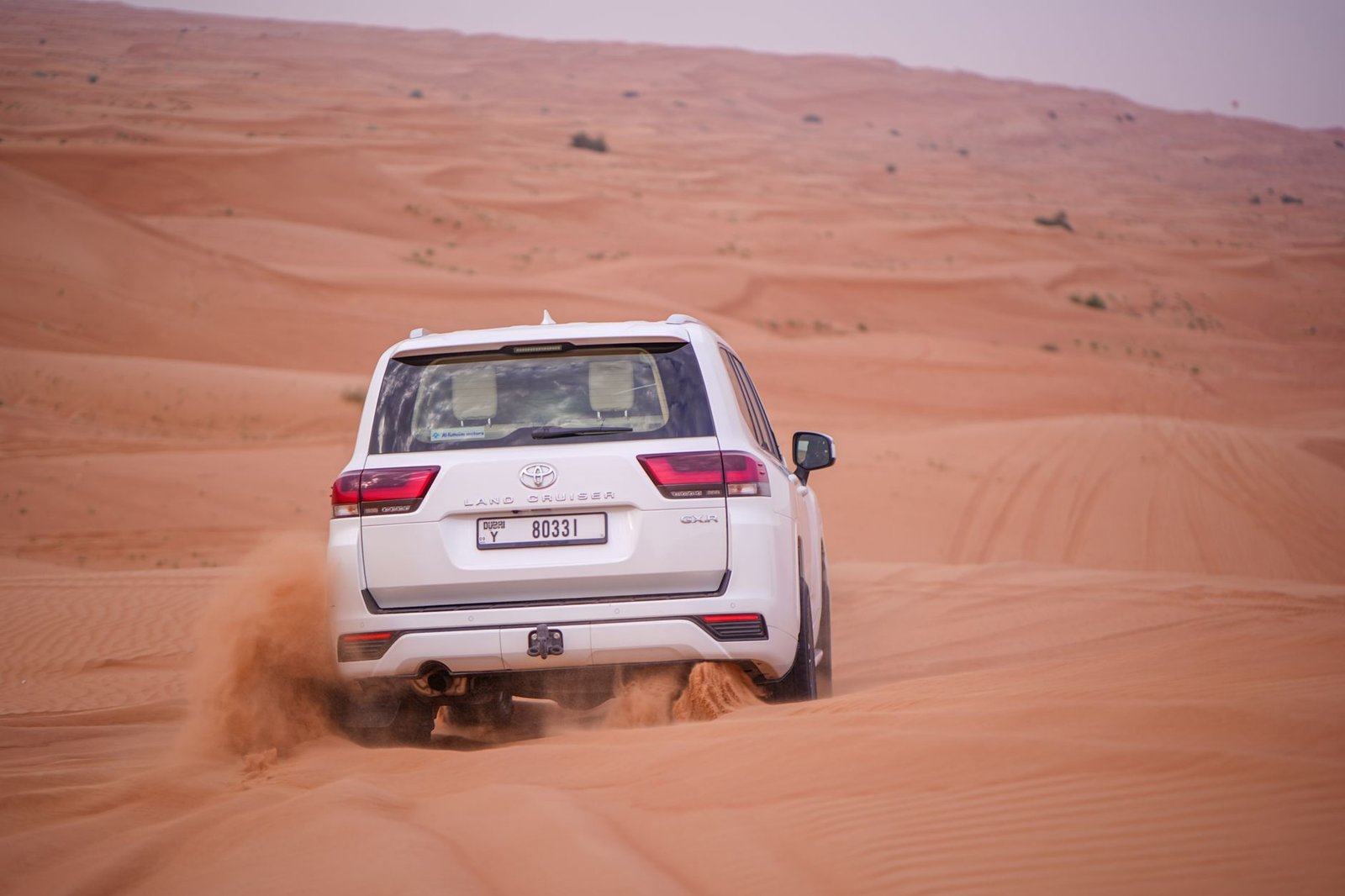
The LC80 versus Patrol GU debate has been running in UAE off-road circles for thirty years. Both vehicles handle everything from Fossil Rock to the dunes of Liwa, both have an active local aftermarket, and both command strong resale values. Yet they feel entirely different on the trail — and the differences matter when you’re weighing up which platform to build.
This is a practical, on-ground comparison written for UAE conditions: sand, wadi, mountain track, and long desert runs. No manufacturer specs recycled from brochures — just what these trucks actually do.
Platform Overview
The Toyota Land Cruiser 80 Series ran from 1990 to 1997 and is still the benchmark for overland reliability in the Middle East. It arrived with a coil-sprung live rear axle, a proper low-range transfer case, and — in the HDJ80 variant — Toyota’s legendary 1HD-T / 1HD-FT inline-six turbo diesel. Locking centre and rear diffs came standard on GX and VX spec trucks.
The Nissan Patrol GU (Y61) overlapped and outlasted it, running from 1997 to 2016 and sold new across the region until relatively recently. The GU brought a longer wheelbase, the TD42 or ZD30 diesel (depending on spec), and a well-proven live axle setup front and rear. The later GU V8 petrol (TB48) produced big power numbers but fundamentally changed the maintenance equation.
Off-Road Geometry: Angles, Flex, and Ground Clearance
On paper the numbers are close. In practice the Patrol GU has a slight edge in approach and departure angles, partly because the front overhang is marginally shorter relative to wheelbase. Both trucks cross the same lines in the UAE terrain catalogue — neither is limited by geometry in anything short of competition rock-crawling.
Suspension flex is where they diverge more noticeably. The LC80’s front coil springs are stiffer than the GU’s leaf front (early GU) or torsion bar (later GU); the LC80 articulates better stock and responds more predictably to a lift. Patrol GU suspension lifts are cheaper but require more tuning to get alignment right.
Ground clearance stock-for-stock is effectively equal at around 220–225mm. Both benefit from the same 50mm lift with slightly larger tyres — the sweet spot for UAE use without needing major driveline modifications.
Engine and Drivetrain: Reliability in Heat
The 1HD-T/FT in the LC80 is one of the most durable diesel engines ever built. It runs cool, tolerates poor fuel quality, and — crucially in the UAE summer — doesn’t overheat under sustained low-speed crawling. The main maintenance items are well-documented: injectors, head gasket on the 1HD-T (rare but possible), and timing belt at interval. A well-serviced HDJ80 will pass 400,000 km without major drama.
The TD42 in the Patrol GU is equally durable — some argue more so, being a simpler naturally aspirated unit (in base spec) that tolerates neglect. Timing chain rather than belt removes one service item entirely. The TD42T (turbo) adds power but narrows the reliability margin slightly due to heat soak. The ZD30 engine fitted to some GU variants has a documented head and piston weakness under UAE summer heat; it’s a known issue with fixes available, but it’s a factor when evaluating used examples.
Both have excellent UAE parts availability. LC80 engine and drivetrain parts are stocked locally and available OEM; Patrol GU parts are similarly accessible and often cheaper for mechanical components.
Sand Performance
At Lahbab or Big Red, both trucks perform well with correct tyre pressures (12–15 PSI) and low-range. The LC80’s locking diffs give it an advantage in technical situations — a diagonal articulation scenario that would require throttle finesse in an open-diff GU is straightforwardly resolved with the rear locker engaged.
The Patrol GU’s longer wheelbase is a mild disadvantage in tight inter-dune corridors but an advantage in high-speed dune crossings where stability matters. Many experienced UAE desert drivers prefer the GU’s feel in fast dune runs; many prefer the LC80’s locked-diff confidence in slow technical situations.
Neither truck is obviously superior in sand. The difference between a skilled driver in a GU and a less-experienced driver in a locked LC80 is larger than the difference between the trucks themselves.
Parts Cost and Aftermarket
The Patrol GU wins clearly on parts cost. Filters, brakes, gaskets, and suspension components are consistently 20–40% cheaper than LC80 equivalents. The GU aftermarket — lift kits, bull bars, skid plates, drawer systems — is wide and competitive in the UAE.
The LC80 aftermarket is arguably richer at the high end: Old Man Emu, ARB, and Ironman all produce comprehensive lift packages. But you pay more for them. LC80 aftermarket parts sourced locally are excellent; budget-conscious builders will find GU Patrol aftermarket parts stretch further.
For resale, both hold value well in the UAE used market. Clean, low-mileage HDJ80s command a significant premium that has only increased in recent years — a well-kept LC80 GX or VX is an appreciating asset. The GU’s broader production run means more supply and accordingly lower price ceilings, but also lower floor pricing on project trucks.
Comfort and Daily Usability
The LC80 is a more refined daily driver. The interior on VX spec is genuinely well-appointed for a truck from the early 1990s, the ride is composed, and noise levels are lower. It’s a credible family vehicle that happens to also be a serious off-roader — the formula Toyota perfected.
The Patrol GU is more utilitarian, especially in base and ST spec. The ride is firmer, the cabin noisier, and the ergonomics decidedly older-generation. The Ti and ST-L specs are more comfortable but still don’t match the LC80 cabin experience. Patrol enthusiasts often say this is a feature rather than a bug: the GU is a working truck that doesn’t pretend to be anything else.
Head-to-Head Summary
| Category | LC80 (HDJ80) | Patrol GU (TD42) |
|---|---|---|
| Off-road geometry | Excellent | Excellent (slight approach edge) |
| Suspension flex (stock) | Better | Good |
| Engine durability | Outstanding (1HD-T/FT) | Outstanding (TD42) / Fair (ZD30) |
| Locking diffs (stock) | Centre + rear (GX/VX) | None stock (most specs) |
| Parts cost | Moderate–High | Lower (20–40% less) |
| Aftermarket depth | Very deep | Deep, better value |
| Sand performance | Excellent (locked) | Very good |
| Daily comfort | Better | Good / Utilitarian |
| Resale value (UAE) | Strong / Appreciating | Strong / More stable |
| Purchase price (used) | Higher | Lower |
Which One Should You Buy?
Buy the LC80 if: you want the complete package — refinement plus off-road capability — and you’re prepared to pay the premium for a clean example. If you’re building a serious overland vehicle that also serves as a family daily, the LC80 HDJ80 GX or VX is hard to beat. The locking diffs make it the more capable truck out of the box without modification.
Buy the Patrol GU if: you want maximum capability per dirham spent, you’re planning a heavy build (the GU takes modifications slightly more easily), or you simply prefer a more purpose-built feel on the trail. A TD42 GU with a modest lift and good tyres will go everywhere the LC80 goes at significantly lower cost.
Either way, check the upcoming 4WD Authority drive calendar — both platforms are welcome on our convoys, and there’s no better way to get a feel for both trucks in UAE terrain than running them back-to-back on an organised trail day.
Frequently Asked Questions
Is the LC80 or Patrol GU better for UAE desert driving?
Both are excellent UAE desert trucks. The LC80 has a slight edge with its standard locking diffs and more refined long-distance comfort. The Patrol GU has lower running costs and a strong following among drivers who prefer its raw, purpose-built character. In practice, driver skill and correct tyre pressure matter more than which platform you’re in.
Which is cheaper to maintain — LC80 or Patrol GU?
The Patrol GU is consistently cheaper to maintain in the UAE. Mechanical parts — filters, brakes, gaskets, suspension components — run 20–40% less than LC80 equivalents. Aftermarket lift kits and accessories are also better value. The LC80 commands higher parts prices but also holds stronger resale value, partly offsetting the cost difference over time.
Does the Patrol GU have locking differentials?
Most Patrol GU variants (TD42, ZD30) do not have locking differentials as standard. A rear locker can be added aftermarket — ARB Air Locker and Powertrax are popular choices in the UAE. The LC80 GX and VX spec come with factory locking centre and rear diffs, which is a meaningful advantage in technical off-road situations.
Is the ZD30 engine in the Patrol GU reliable in UAE heat?
The ZD30 has documented issues with head gasket and piston failure under sustained high-heat operation. It is not as durable as the TD42 in UAE summer conditions. Fixes exist — an uprated head stud kit, revised tune, and careful monitoring — but buyers should budget for this when evaluating a ZD30 GU. The TD42 is the preferred engine for desert-focused builds.
Further reading: Patrol Y62 vs Land Cruiser 200 · Toyota Land Cruiser 300 · LC300 & LC200 Upgrades · How to Buy a Used 4×4 UAE
