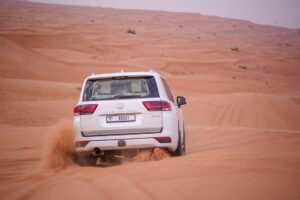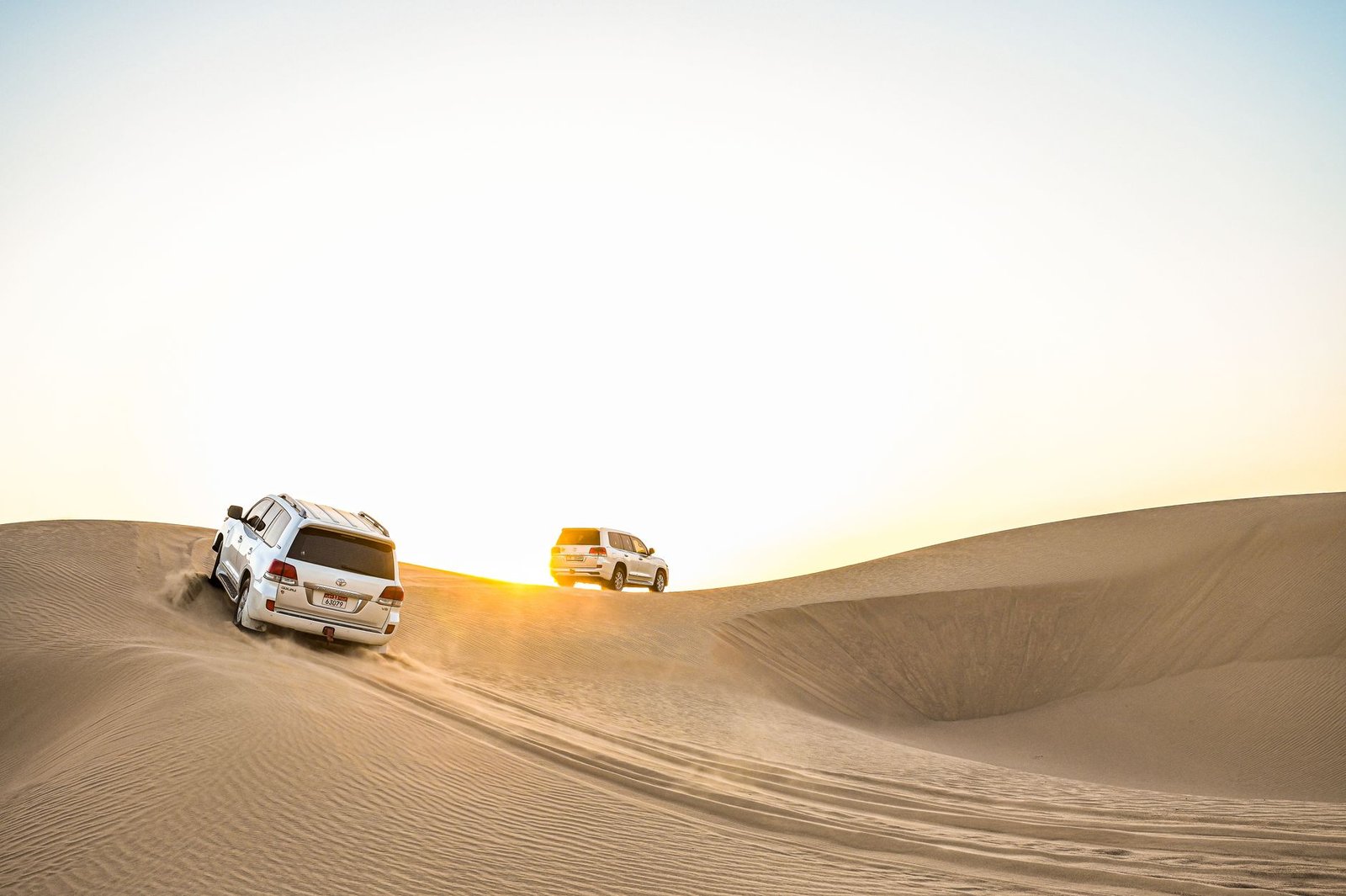
The UAE packs an astonishing range of off-road terrain into a compact geography: sheer quartzite ridges in Sharjah, green wadis cutting through the Hajar Mountains, and the endless red erg of the Rub’ al Khali fringe. Whether you’re running a stock Land Cruiser 80, a built-up Nissan Patrol, or just starting out in a rental, there’s a track here for you.
This guide covers the six best off-road tracks in the UAE, rated by difficulty, terrain type, and what to expect on the ground.
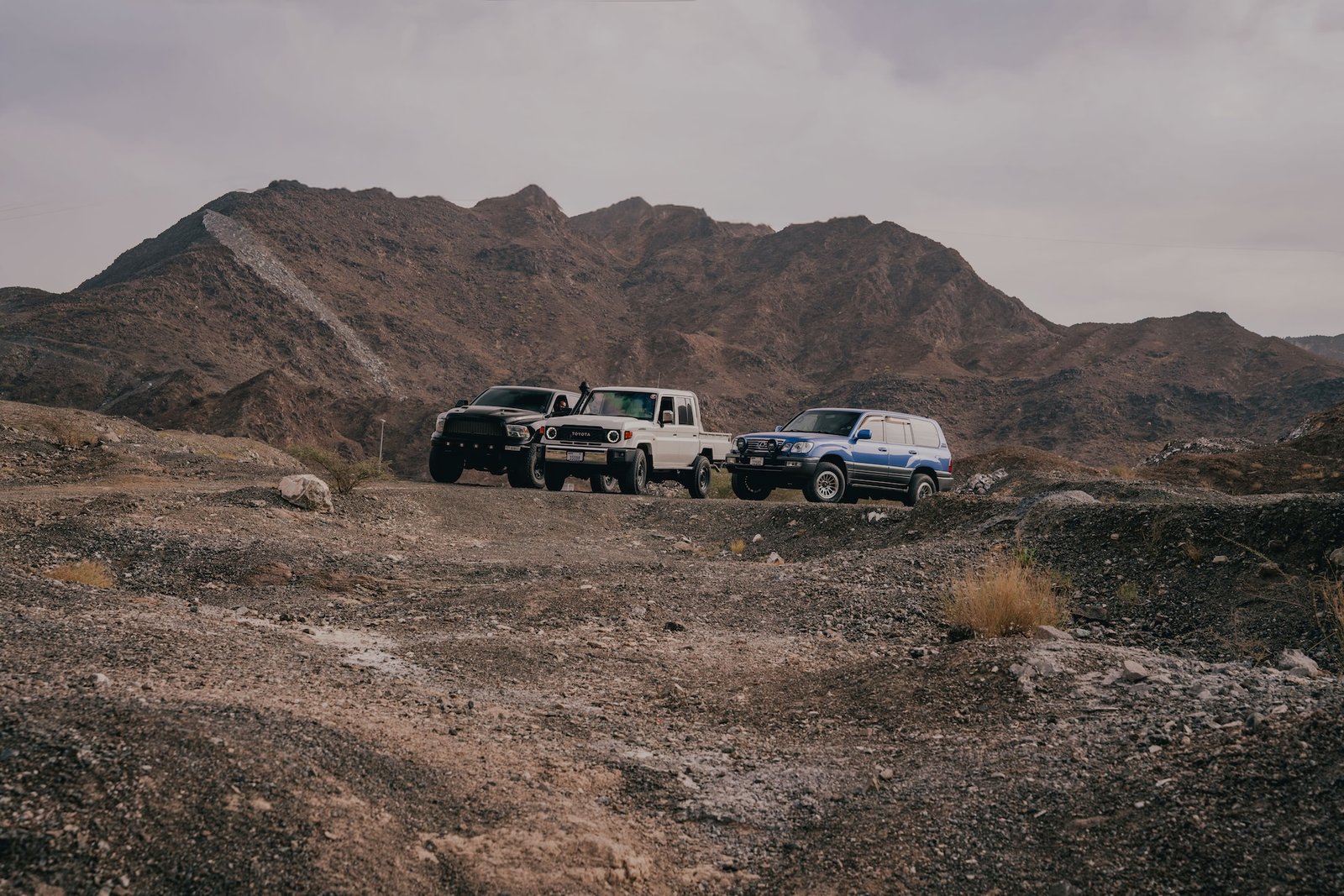
1. Fossil Rock — Sharjah
Difficulty: ⭐⭐⭐ Intermediate | Terrain: Rocky ridges, loose shale, sand pockets | Drive from Dubai: ~1 hr
Fossil Rock (Jebel Maleihah) earns its name from the Cretaceous-era marine fossils embedded in the quartzite. The main challenge is the switchback ridge climb: steep, narrow, and uneven — you’ll want a rear locker and good clearance. At the top, a 360° view across Sharjah and the Al Faya desert makes the climb worthwhile.
The descent routes vary in difficulty; the north face gives beginners a gentler line while the south face drops sharply and rewards committed throttle work. Water and fuel from the Fossil Rock Café at the base before you head up.
What to bring: Tyre deflators, compressor, recovery boards. The loose shale can catch tyres at odd angles — sidewall protection matters here.
2. Hatta — Dubai
Difficulty: ⭐⭐ Beginner–Intermediate | Terrain: Wadi, gravel, mountain track | Drive from Dubai: ~1.5 hr
The Hatta mountain enclave offers the UAE’s most accessible wadi driving. The main Wadi Hub route follows a graded track past the Heritage Village and up into the Hajar foothills, opening into side wadis that reward exploration. Rock-hopping in the upper sections is genuinely technical, but the main track stays manageable for a standard 4×4 with low-range.
The Hatta Dam is a photographic stop worth the detour. If you’re overnighting, the Hatta Damani Lodges sit right at the edge of the off-road zone — no need to camp rough to get an early morning start on the trails.
Best season: October–April. Summer temperatures in the gorges can exceed 45 °C; carry 5 L of water per person minimum year-round.
3. Big Red (Al Badayer) — Sharjah
Difficulty: ⭐⭐⭐⭐ Experienced | Terrain: High dunes, inter-dune bowls | Drive from Dubai: ~1 hr via Al Dhaid
Big Red is the UAE’s most iconic single dune — a 100-metre wall of red sand that’s been a rite of passage for UAE four-wheelers for decades. The dune field beyond it (Al Badayer) is a full sea of cresting red dunes and fast inter-dune runs that will test your throttle control and momentum management.
Running Big Red requires sand-specific technique: approach speed, crest commitment, and a clear line to avoid the soft sides. Deflate to 12–15 PSI before attempting — underinflated tyres are the single biggest difference between a clean run and a dig-out. The area has recovery crews on busy weekends but don’t count on it during the week.
Good to know: Big Red sees heavy traffic on Thursday evenings and Fridays. Weekday afternoons are quieter and safer for less experienced sand drivers.
4. Madam Plateau — Sharjah / Fujairah Border
Difficulty: ⭐⭐⭐ Intermediate | Terrain: Gravel plateau, rocky drops, sand traps | Drive from Dubai: ~1.5 hr
Madam is underrated. The plateau approach looks flat on paper but breaks into a maze of gravel ridges, ancient falaj channels, and boulder gardens that demand route-reading ability. The eastern edge drops into a series of steep descents toward Fujairah — committing to the wrong line means winching or a long walk out.
The historical interest adds to the draw: Madam has one of the UAE’s oldest communities and Bronze Age remains are scattered across the plateau. Slow down and look around.
Navigation note: Mobile signal disappears fast. Download offline maps before leaving the tarmac — Google Maps’ offline cache does not cover the detail you’ll need.
5. Lahbab Desert (Red Dunes) — Dubai
Difficulty: ⭐⭐ Beginner–Intermediate | Terrain: Rolling red dunes, soft corridors | Drive from Dubai: ~45 min via Al Qudra
Lahbab is Dubai’s closest proper dune field and the go-to for first-timers learning sand technique. The dunes are gentler than Al Badayer and the terrain is forgiving enough that a conservative driver with low-range and properly deflated tyres can navigate without drama. Most commercial dune-bashing tours run here, which means well-worn corridors you can follow if you’re uncertain.
The flip side: it’s busy. Friday afternoon at Lahbab involves dozens of vehicles and the occasional collision from drivers who’ve watched too many YouTube stunts. Morning sessions on weekdays are calmer and the soft morning light makes for better photography.
Rental option: Not confident in your vehicle? Check our 4×4 rental fleet — all units are fully kitted for sand before handover.
6. Liwa — Abu Dhabi
Difficulty: ⭐⭐⭐⭐⭐ Expert | Terrain: Mega-dunes, remote erg, no services | Drive from Dubai: ~3 hr
Liwa is the UAE’s definitive off-road experience — the edge of the Empty Quarter, with dunes that top 200 metres and cross-dune distances that swallow GPS tracks. The 4WD Authority Liwa convoy runs twice a year with full recovery support, navigation, and overnight camping; attempting Liwa solo without experienced navigation is genuinely dangerous.
Dune crests here are knife-sharp and the slip faces are vertical. You’ll need high-float tyres, a working GPS, satellite communication, at least one other recovery-equipped vehicle, and enough fuel and water for a full desert day. The reward is solitude and scenery that no coastal track in the country can match.
For your vehicle: Liwa demands a mechanically sound platform. If you’re running an LC80, ensure your suspension, cooling, and fuel system are trip-ready; Patrol GU owners should check cooling and diff guards before departure.
Essential Tips for Off-Roading in the UAE
- Tyre pressure: Deflate to 18–22 PSI for hard-pack, 12–16 PSI for soft sand. Always re-inflate before returning to tarmac.
- Low-range: Engage low-range before you need it — not while you’re stuck.
- Recovery kit: Snatch strap, shackles, shovel, and compressor are the minimum. Add a hi-lift jack and MaxTrax for solo runs.
- Timing: Early morning or late afternoon — cooler temperatures reduce overheating risk and the light is better.
- File a plan: Tell someone where you’re going and when to expect you back, especially for remote routes.
Frequently Asked Questions
Do I need a permit to drive off-road in the UAE?
No permit is required for recreational off-road driving on the established tracks covered in this guide. Some protected areas (dunes near Liwa Nature Reserve, certain wadi zones in Fujairah) have seasonal restrictions — check with the relevant emirate’s environment authority before entering unfamiliar zones.
What is the best 4×4 for off-roading in the UAE?
The Toyota Land Cruiser (70 Series, 80 Series, 200 Series) and Nissan Patrol (GQ, GU, Y62) are the most capable and best-supported vehicles for UAE off-roading. Parts availability, local knowledge, and proven desert performance make these the community standard. A stock Land Cruiser 80 or Patrol GU handles every track in this guide with appropriate technique.
What tyre pressure should I use for dune driving in the UAE?
For soft red-sand dunes (Lahbab, Big Red, Liwa), deflate to 12–16 PSI. For mixed gravel and hard-pack tracks (Hatta, Madam, Fossil Rock approach), 18–22 PSI is a good starting point. Always carry a compressor — re-inflate before driving on tarmac to avoid tyre damage and instability at speed.
Is Liwa safe for beginners?
Liwa is not suitable for beginners or solo drivers. The dunes are among the largest in the world, services are non-existent, and a single navigation error can strand a vehicle hours from help. Join an organized convoy with recovery support for your first visit — 4WD Authority runs guided Liwa expeditions with full equipment and experienced trail leaders.
Further reading: Wadi Showka Trail Guide · Hatta Off-Road Guide · Big Red Dubai · Wadi Driving Safety UAE