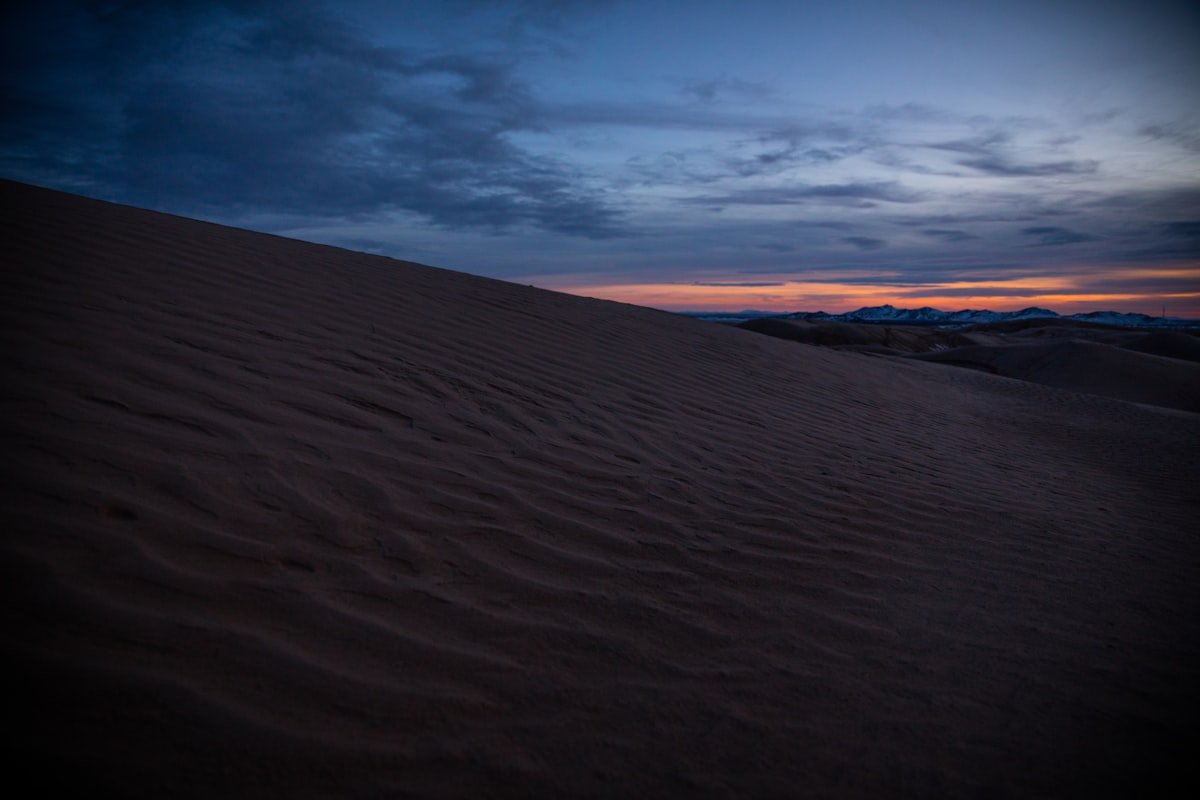
The first time you point a 4×4 at a 60-metre dune face in Liwa, every instinct built on tarmac works against you. You want to brake when it gets steep. You want to turn when the rear slides. You want to accelerate when you feel the wheels spinning. All of it is wrong.
This guide gives you the correct technique — tyre pressure, 4WD settings, ascent and descent procedure, and what to do when you get stuck — based on marshalling hundreds of convoys across Liwa, Big Red, Lahbab, and the Fossil Rock Desert near Mleiha.
Before You Go — Vehicle Preparation
The single most important preparation for sand dune driving is tyre pressure. Drop to 18–22 PSI for soft Liwa-style dunes, or 22–26 PSI for compacted desert tracks. Standard road pressure (35+ PSI) will bury your vehicle. Lower pressure expands the tyre footprint, distributing weight across more sand and dramatically reducing the chance of digging in.
Everything else — recovery gear, fuel, water — is critical but secondary to correct tyre deflation. A well-equipped vehicle at full road pressure will get stuck on a moderate dune. A basic 4×4 at 20 PSI will cross most UAE terrain.
- Tyre pressure: 18–22 PSI soft dunes / 22–26 PSI firm sand — check with a digital gauge, not a petrol station unit
- Fuel: Minimum ¾ tank before entering Liwa or Lahbab. No petrol stations inside the dune fields.
- Water: 4 L per person for full-day drives in summer; 3 L minimum in winter
- Air filter: Sand ingestion is the leading cause of dune-related engine damage — inspect and replace before every Liwa trip
- Recovery kit: Hi-Lift jack (48″), MaxTrax x2, 9 m kinetic snatch strap (min 11,000 kg MBS), bow shackles x2, portable air compressor
- Share your route: Drop a GPS pin and share a live location before entering any remote dune field
4WD Settings for Sand
For most UAE sand dunes: engage 4WD High (4H) for firm, compacted sand at speed. Switch to 4WD Low (4L) for soft deep sand, steep ascents, or any recovery situation. Never drive in 2WD on sand — you will get stuck within minutes.
The rules by terrain:
- 4H (4WD High): Firm desert tracks, moderate dunes, convoy travel between dune fields at 40–80 km/h
- 4L (4WD Low): Big Red face, Tal Mireb/Moreeb, any dune over 20 m with a soft face, all recovery situations
- Rear diff lock: Engage on steep ascents and in recovery. Disengage on flat firm sand — a locked diff causes understeer and tyre scrub on level ground.
- Automatics (LC300, Patrol Y62): Use Sport or Manual mode on steep climbs to prevent a gear change mid-ascent. A shift from 2nd to 3rd at the wrong moment kills your momentum.
- Hill Descent Control (HDC): On firm or lightly compacted sand, HDC provides useful speed control on descents — engage it and lift your foot off the brake. On soft or deep sand, disengage HDC and use 4L engine braking alone; the system can lock the wheels and cause the vehicle to dig in on loose terrain.
How to Climb a Sand Dune
Approach the dune face straight on at 35–45 km/h. Maintain momentum without accelerating hard — wheel spin digs you in. If the vehicle starts to slow, do not floor the throttle. Back off, reverse straight down, and approach with more speed from further back.
Five-step ascent procedure:
- Reconnoitre first. Walk the line before you drive it on dunes over 20 m. Check the crest — a blind crest can drop vertically on the reverse face and you will not see it until it is too late.
- Approach angle. Always 90° to the dune face, straight up. Any diagonal angle risks a side-roll. If you cannot approach straight on, find a different line.
- Speed and momentum. Choose your run-up distance so you arrive at the base doing 35–45 km/h. Hold that speed on the face — do not accelerate further or wheel spin will dig you in.
- If you stall mid-climb. Manual: depress the clutch immediately. Automatic: shift to neutral. Apply the handbrake. Reverse straight down in 4L. Do not attempt to turn on the slope.
- At the crest. Ease off the throttle as you approach the top — never go over a blind crest at speed. The reverse face may drop steeply. Crest slowly, assess, then proceed.
Vehicle-specific notes:
- Land Cruiser LC76: 4L + rear locker on faces over 30 m. Factory 16″ tyres deflated to 18 PSI perform exceptionally on Liwa sand.
- Nissan Patrol Y61 (TB48): 4L, keep revs above 1,500 RPM — the engine stalls easily at low RPM on steep climbs. Use 2nd gear 4L for most ascents.
- Prado 150: Use Crawl Control (if equipped) set to speed 2 on steep soft-sand climbs. It manages throttle and braking independently.
- Land Rover Defender 110: Terrain Response set to Sand. The system manages throttle, diff lock, and suspension simultaneously.
Descent Technique
Descend steep dunes in 4WD Low at walking pace with the vehicle pointing straight down. Do not brake hard — you will skid and potentially roll. On firm sand, Hill Descent Control (HDC) can help — engage it and lift your foot off the brake pedal. On soft or deep sand, disengage HDC entirely and rely on 4L engine braking; HDC can lock wheels and cause dig-in on loose terrain.
- Always descend in 4L — engine braking controls speed without needing the brake
- If the rear slides, steer into the slide (the same direction the rear is moving). Do not brake. This is the opposite of tarmac instinct.
- Steep reverse faces over 35°: consider reversing down rather than facing forward — the vehicle’s weight distribution is more stable in reverse on extreme gradients
- Place MaxTrax at the base of soft faces where vehicles tend to dig in as momentum is lost on descent
Recovery — Getting Unstuck
If you are stuck: stop immediately. Do not spin the wheels — every revolution digs you deeper. Deflate tyres to 16 PSI, place MaxTrax in front of or behind the drive wheels, and drive out in 4L with gentle throttle. If MaxTrax fails, use a kinetic snatch strap pull — inever a static rope.
Step-by-step recovery procedure:
- Stop and assess. Are you wheel-spinning, high-centred, or both? Different situations need different recoveries.
- Deflate to 16 PSI2 if you have not already done so.
- Clear sand from all four tyres by hand or by shovel. You need the tyre’s full contact area free.
- Place MaxTrax in front or behind the stuck wheel in the direction you want to move. Both boards, not one.
- Drive out in 4L with smooth, gentle throttle. No wheel spin — if the MaxTrax launches, you have used too much power.
- If self-recovery fails, attach a kinetic snatch strap between a rated recovery point on your vehicle and a rated tow point on the recovery vehicle. Both vehicles move simultaneously — the kinetic stretch provides the extraction energy. Do not use a rigid tow rope.
- After recovery: drive 50 m clear of the stuck area, inspect all four tyres for damage, check underbody, re-inflate before returning to tarmac.
Critical rules: Never attach a recovery strap to a tow ball — it will shear off under load. Never stand in line with a stretched kinetic strap. Always use rated recovery points only.
Best Dune Locations in the UAE
Liwa Oasis, Abu Dhabi — Advanced
The largest dune system in the UAE, with Tal Mireb (Moreeb Dune) reaching 300 m. Requires experienced drivers and full recovery kit. The Liwa International Festival in late December closes access to some areas — plan around it. GPS: 23.1406°N, 53.7722°E.
Big Red (Al Hamar), Dubai — Beginner to Intermediate
The most accessible dune from Dubai — a 100 m face on the Dubai–Hatta Road, 45 km from the city. Firm sand on weekends due to heavy traffic. Ideal for first-timers; go on Thursday morning to avoid quad bikes and beach buggies. GPS: 24.9960°N, 55.6740°E.
Lahbab Desert, Dubai — Intermediate
Softer, more varied terrain than Big Red with multiple line choices. Popular for club drives and good for building technique without the extreme commitment of Liwa. GPS: 24.9483°N, 55.7823°E.
Fossil Rock Desert, Sharjah — Intermediate
The red sand dune field surrounding Jebel Mleiha in Sharjah, approximately 65 km from Dubai via the E102 Sharjah–Kalba Road. Open-access terrain with a mix of moderate dunes and sandy bowls — less trafficked than Big Red and well-suited to drivers building confidence between Lahbab sessions and a Liwa attempt. The adjacent Mleiha Archaeological Centre is worth a visit. Go on a weekday to avoid weekend congestion. GPS: 25.1364°N, 55.8303°E.
Frequently Asked Questions
What tyre pressure should I use for sand dunes in the UAE?
Drop tyre pressure to 18–22 PSI for soft dunes such as Liwa, or 22–26 PSI for firmer desert tracks. Always carry a portable air compressor to re-inflate to road pressure (32–35 PSI) before returning to tarmac. Driving at sand pressure on highway causes tyre overheating and blowout risk — re-inflate before you reach the paved road.
Can a Nissan Patrol drive on sand dunes?
Yeu — the Nissan Patrol Y61 (TB48 petrol) and Y62 are among the most capable sand vehicles available in the UAE. The Y61’s mechanical rear locker and high ground clearance make it the preferred choice for experienced desert drivers. Set to 4L, rear diff locked, tyres deflated to 18–20 PSI for soft Liwa sand.
Is dune driving dangerous?
Sand dune driving carries genuine risk — rollovers, remote entrapment, and heat-related illness are the most common incidents. Driving in an experienced group with a qualified marshal, carrying a full recovery kit, and sharing your GPS route before departure reduces risk substantially. 4WD Authority guided drives are marshal-led specifically to mitigate these risks for both beginners and experienced drivers.
The fastest way to build dune technique safely is to drive with experienced marshals who can coach you in real time. Our convoy drives cover Liwa, Big Red, and Lahbab with vehicle briefings before every run.